On this page
- What does Bunaken marine life include?
- How many coral and fish species are recorded?
- Which claims are hard to verify?
- What have sources reported at specific sites?
- Are dugongs part of the picture?
- What grows in the mangroves and seagrass?
- Where does the coelacanth fit?
- How should you treat the reef while you are there?
- What else do people ask about Bunaken's wildlife?
- Which sources support this page?
- How do I reach the desk?
By Bunaken Island Editorial Desk
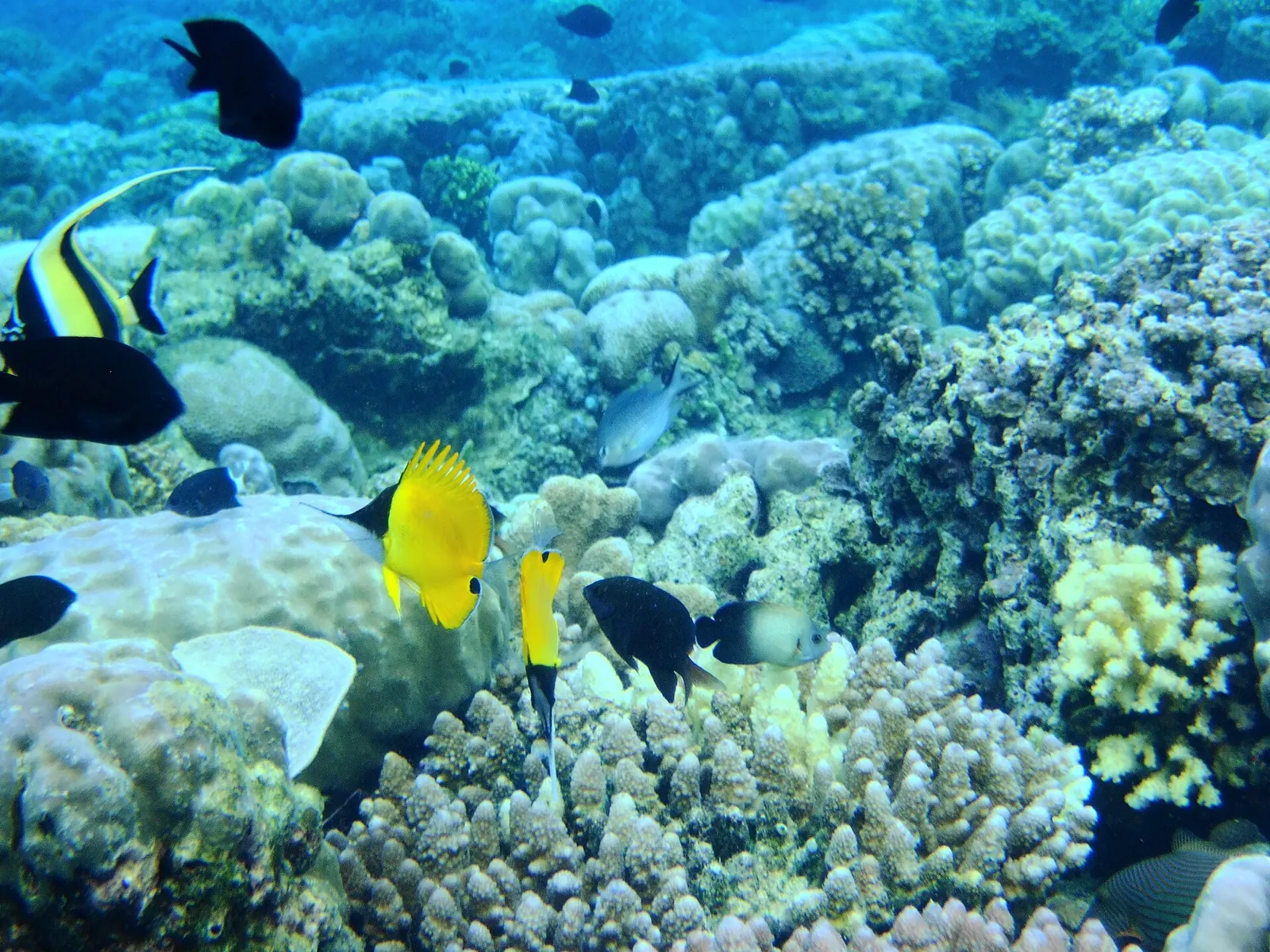
Bunaken marine life includes about 390 recorded coral species and, according to Wikipedia, about 2,000 fish species, along with giant clams, turtles and the dugong. These figures do not carry equal weight, and some popular comparisons are reported claims, not measurements. Nobody can tell you what a single dive will show.
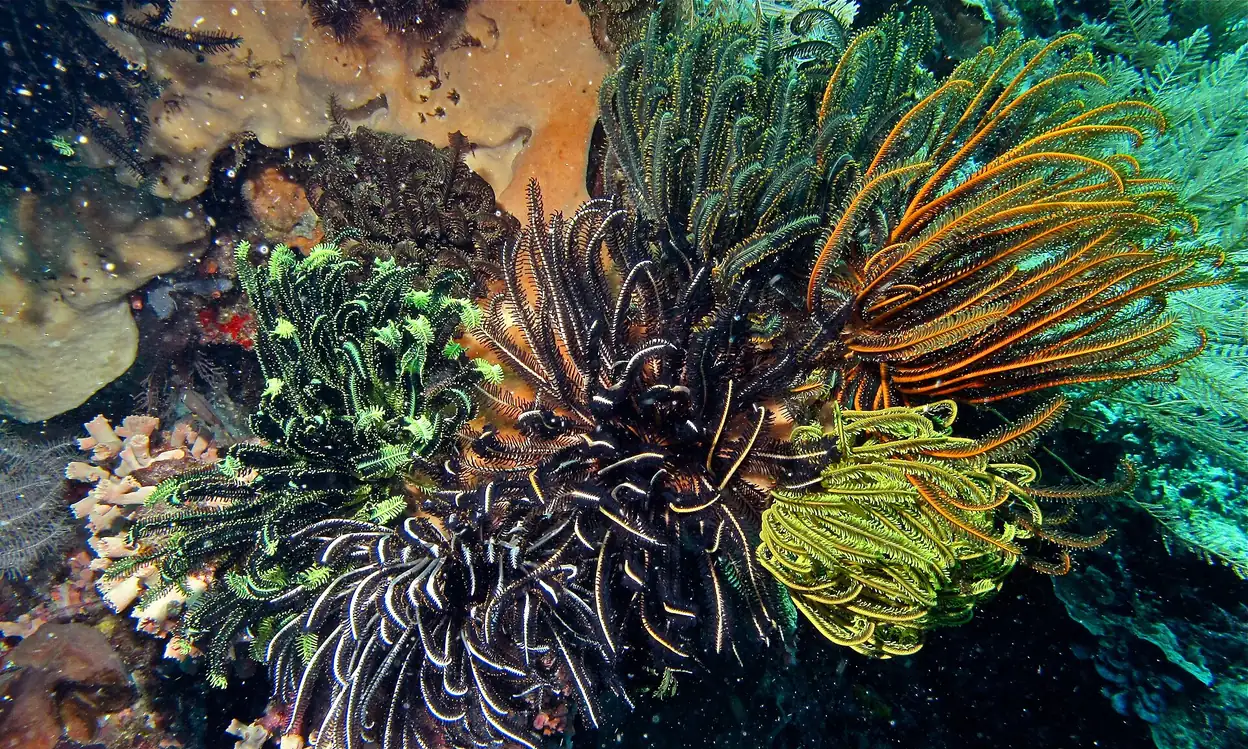
What does Bunaken marine life include?
The setting explains much of the variety. UNESCO places the Bunaken Tangkoko Minahasa Biosphere Reserve in the heart of the Coral Triangle, and the reserve, 746,405.92 ha in all, has the national park in its core area.
The seabed matters as much as the location. UNESCO's Tentative List text says the sea between the park's islands is 200 to 1,840 m deep, and our Bunaken diving guide explains how close that depth comes to shore. That is why a turtle on the reef top and a coral wall can share one outing, and why the coelacanth story belongs here.
For a quick sense of who lives here, the main groups covered below are:
- Corals, with sea fans and giant sponges reported on the walls.
- Reef fish, including butterflyfish, batfish and snappers.
- Giant clams, with a striking species claim attached.
- Green and hawksbill turtles, covered on the Bunaken turtles page.
- The dugong, a protected species with little data behind any sighting talk.
- Mangroves and seagrass, the park's less visited habitats.
How many coral and fish species are recorded?
The two numbers most often quoted are about 390 coral species and about 2,000 fish species. Both reach us through Wikipedia's park article, but they are not equally well supported. The coral figure is cited there to a named reef assessment, so it has a trail back to survey work. The fish figure reaches us simply as Wikipedia's statement, so it is best read as an approximate scale.
| Subject | Figure | Who reports it | How to read it |
|---|---|---|---|
| Coral species in the park | About 390 | Wikipedia, citing a reef assessment | The best-grounded count here |
| Fish species in park waters | About 2,000 | Wikipedia | Approximate scale, for the whole park |
| Giant clam species | Seven of the world's eight | Wikipedia's Bunaken article | Attributed; a striking claim worth a second source |
| Butterflyfish around Lekuan or Fukui | More than 33 species may be spotted | Wikipedia's Bunaken article | A site-level possibility, not a tally for one dive |
| Coral genera on a vertical wall | 13 genera, 25 to 50 m | Wikipedia's park article | A narrow measure of one wall zone |
| Mangrove species in the park | 34 to 46 | UNESCO | A range given by one source |
Pay attention to the unit. A species count for the whole park and a genus count for one wall zone measure different things, and 13 genera does not contradict 390 species. Marketing copy sometimes drops the unit or the area, which makes small and large numbers look interchangeable.
Which claims are hard to verify?
Wikipedia reports, as a claim, that the park has seven times more coral genera than Hawaii and over 70% of known Indo-Western Pacific fish species. You will see versions of both on many travel pages, often with the attribution removed. We repeat them here only as claims. A comparison with Hawaii depends on which survey of Hawaii is used, and a percentage of a whole ocean region depends on which species list sits underneath it. Neither is something you can check from a brochure.
Reef condition is another weak spot, and we publish no coral-cover percentage. Sulawesi.com, a seller of tours as well as a travel publisher, reports coral lost to bleaching on some shallow reefs and deep walls largely intact, but it cites no survey. Wikipedia names the pressures as coral mining, anchor damage, blast and cyanide fishing, diving itself and trash. The conservation page follows those threats further.
Sharks are a frequent question, and the sources on this page give no species list or sighting rate, so an operator's passing mention is a long way from a dependable expectation. When you read any wildlife number, four questions sort it quickly:
- Who counted, and did they publish how?
- What area does it cover: one wall, one island or the whole park?
- Is it species, genera or simply kinds of animal?
- Does the source sell trips to see the animal?
What have sources reported at specific sites?
Site-level descriptions are more useful for planning than park totals, as long as you read them as reports of what has been seen and not as a menu.
- Lekuan. Indonesia's tourism ministry site pictures a long wall with crevices, sea fans and giant sponges, and says turtles and Napoleon wrasse come by.
- Fukui. Siladen Resort describes a big, gentle reef where a batfish school is resident, with sand levelling out close to 30 m.
- Mandolin. Siladen Resort mentions midnight snappers, sponges and black coral. Dive The World, an agent, adds whip corals between 20 and 45 m.
The dive sites guide compares these and other sites in terms of depth and conditions.
Are dugongs part of the picture?
Yes, in conservation terms. Indonesia's conservation directorate names the dugong among the park's priority protected species, alongside green and hawksbill turtles. That tells you the animal is a management priority. It says nothing about how often a visitor might see one, so plan your trip on the assumption that you will not. If a sale depends on a dugong sighting, ask what the seller's claim is based on.
What grows in the mangroves and seagrass?
These habitats get less attention than the walls, but they make up a real part of the park. UNESCO counts 34 to 46 mangrove species across the park, concentrated on the small islands and Bunaken. Wikipedia names Thalassia and Enhalus among the seagrass that dominates the shallows of Mantehage and Nain.
The northern islands are where this side of the park is most visible in the official descriptions, and the Mantehage and Nain page sets out what is documented there. A mangrove trail and a coral nursery appear on the park portal's list of facilities, which is the place to start for anyone interested in coral restoration. Ask the park office whether visitors can take part.
Where does the coelacanth fit?
Wikipedia dates the key sighting to 18 September 1997, in a market at Manado Tua, and other sources differ on the place and year. It is not something to plan a holiday around. The coelacanth page works through the differences.
How should you treat the reef while you are there?
Do not touch coral or stand on it, and keep your fins clear of the wall. Wikivoyage tells snorkellers to keep off the coral when they come back in at low tide. Our entrance fee page reports the offences Sulawesi.com names. If you see fresh damage, note the place and time and report it to your guide or to the park office.
What else do people ask about Bunaken's wildlife?
How many coral species in Bunaken?
About 390 coral species are recorded in the park, a figure Wikipedia cites to a reef assessment. It covers the whole park, not one site, and it does not measure the current condition of the reef.
How many fish species in Bunaken?
Wikipedia gives about 2,000 fish species in the park waters. Treat that as an approximate scale. A separate claim that the park holds over 70% of known Indo-Western Pacific fish species is reported only as a claim and is hard to verify.
What fish can you see in Bunaken?
Named reports include more than 33 butterflyfish species around Lekuan or Fukui, per Wikipedia, Napoleon wrasse at Lekuan, per the tourism ministry site, and batfish at Fukui and midnight snappers at Mandolin, per Siladen Resort. None of these is guaranteed on a given dive.
Are there sharks in Bunaken?
Our sources give no shark species list or sighting rate, so an encounter cannot be predicted. If sharks matter to your trip, ask an operator what it has recorded recently and treat the answer as one operator's report.
Are there dugongs in Bunaken?
The conservation directorate names the dugong among the park's priority protected species, so it is part of the park's wildlife. Plan on the basis that you may never see one.
Which sources support this page?
- UNESCO: Bunaken Tangkoko Minahasa Biosphere Reserve
- UNESCO World Heritage Tentative List: Bunaken National Park
- Wikipedia: Bunaken National Park
- Sulawesi.com: Bunaken marine park diving
- Indonesia tourism ministry: Manado and Bunaken
- Siladen Resort: dive sites map
- Dive The World: Manado and Bunaken
- Conservation directorate (KSDAE): Bunaken park profile
- Park booking portal: Bunaken National Park
- Wikipedia: Latimeria menadoensis
- Wikivoyage: Bunaken
- Wikipedia: Bunaken
How do I reach the desk?
If you are planning around particular animals, say so when you write, along with your dates and diving level: WhatsApp +62 811-3941-4563 or bd@juaraholding.com. The desk can tell you what has been published and which questions to put to an operator, but it cannot promise a sighting, and a written offer is the only thing that binds. Our commercial interest is set out on the about page.
Send the desk your dates, group size, and dive level. The desk replies in writing.
Ask the desk on WhatsApp bd@juaraholding.com