On this page
By Bunaken Island Editorial Desk
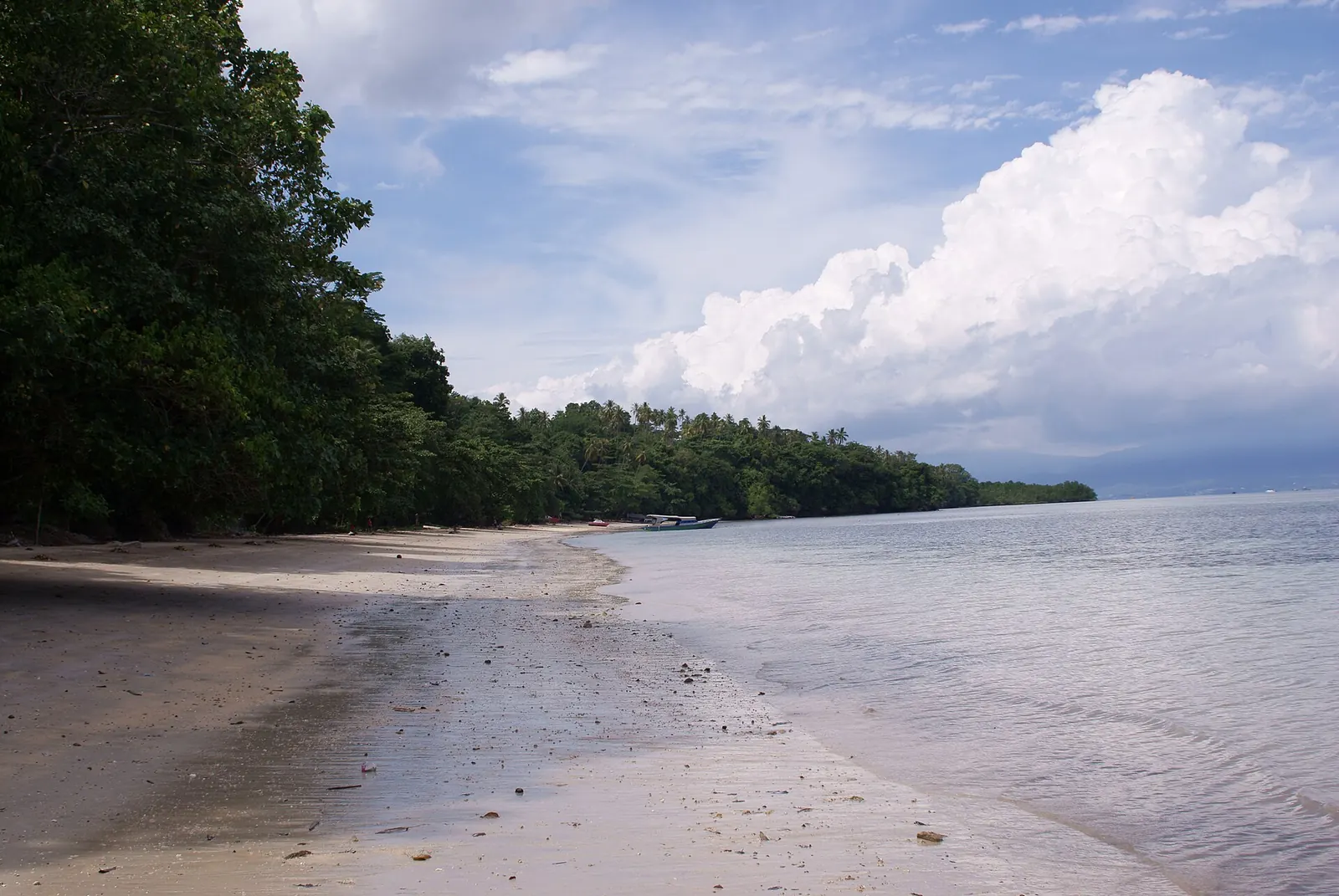
Bunaken weather by month follows Manado's averages: January is wettest at about 415 mm, August driest at about 132 mm, and daytime highs hold at 27 to 28 C all year. Those figures describe the city, not the island. West winds bring rain from November to April, and drier south winds follow from May to October.
What does Bunaken weather by month look like?
Wet from November through about April, noticeably less wet from July to October, and with little change in temperature. The rainfall column below comes from Weather2Travel's averages for Manado, the city across the bay. These are not island measurements. The wind column follows Indonesia's conservation directorate, and the share column is simple arithmetic on the rounded averages, which add up to about 2,930 mm a year.
| Month | Average rainfall in Manado | Share of the year | Prevailing wind |
|---|---|---|---|
| January | About 415 mm | 14% | West |
| February | About 361 mm | 12% | West |
| March | About 304 mm | 10% | West |
| April | About 241 mm | 8% | West |
| May | About 216 mm | 7% | South |
| June | About 201 mm | 7% | South |
| July | About 145 mm | 5% | South |
| August | About 132 mm | 5% | South |
| September | About 141 mm | 5% | South |
| October | About 167 mm | 6% | South |
| November | About 261 mm | 9% | West |
| December | About 344 mm | 12% | West |
Read the year in four stretches rather than twelve separate months:
- December to February: the heavy core, at about 344, 415 and 361 mm. Those three months alone hold close to two-fifths of the annual total. If you are checking Bunaken weather in January or December, this is the band you are in.
- March to June: a steady step down through about 304, 241, 216 and 201 mm. No single month marks a clean break.
- July to October: the low stretch, at about 145, 132, 141 and 167 mm. Bunaken weather in July and August sits at the bottom of the table, yet these four months together still add up to about a fifth of the year's rain.
- November: the sharp turn. The average jumps from about 167 mm in October to about 261 mm.
Which months are wettest and driest?
January is the wettest month in the Manado averages, at about 415 mm over 22 rain days. August is the driest, at about 132 mm over 11 rain days. January therefore gets a little over three times August's rain, and about twice as many rain days. Put another way, roughly seven days in ten are rain days in January, and about one in three in August.
The driest month is not a dry month. A month with about 132 mm is still a wet one by the standards of many travellers' home climates, so pack for showers in any season.
Sources also draw the seasons differently, and the differences are worth seeing side by side:
| Source | Wet period | Dry period |
|---|---|---|
| Indonesia's conservation directorate | November to April (west winds, rain on the north coast) | May to October (drier south winds) |
| Wikivoyage | November to mid-April | May to October |
| Siladen Resort (operator) | No wet period given | April to November |
The first two broadly agree. Siladen Resort draws a wider window that takes in April and November, which average about 241 and 261 mm in the city, both wetter than any month from May to October. That does not make the resort wrong about its own stretch of coast, but its dry season should not be read as a rain-free one. Set against the city averages, the split is stark: about two-thirds of Manado's yearly rain falls from November to April.
How hot does it get?
Not very, and barely differently by month. Weather2Travel's Manado averages put daytime highs at 27 to 28 C all year, with 5 to 7 hours of sunshine a day. Siladen Resort, describing its own dry season, gives air near 30 C and water about 28 C. Those are different sources measuring different things, so keep them apart rather than merging them into a single range.
Because the heat hardly moves, temperature will not help you choose a month. Rain and wind do the work in this climate. Sea temperature is a similar story: Wikipedia gives 27 to 29 C for the waters of Manado Bay, while Bottles Up Diving says 26 to 30 C.
Which winds shape the year?
Two, according to the conservation directorate. West winds blow from November to April and bring rain to the north coast. South winds blow from May to October and are drier. You can see that hand-over in the table: rainfall climbs in the same month that the west wind takes over, and eases as the south wind returns.
In our judgement, wind matters more than the rain gauge for anything on the water. Wikivoyage says storms in the wet season can last several days and reduce marine visibility. Sulawesi.com, a travel publisher that also sells tours, warns that the afternoon public boat is most likely to be cancelled or delayed from November to March. If your plans rest on a crossing in those months, leave slack, and read our Manado to Bunaken guide for the boat options.
The island's shape adds a local twist. Dive The World says the curve of Bunaken keeps its south side usually calm on the surface. That is one agent's description of sea state, not a measurement, and it says nothing about rain.
Does the island differ from Manado?
Probably, though the sources on this page put no number on it. Wikivoyage says Bunaken gets less rain than the mainland and is well served by sea breezes. If that holds, the rainfall column overstates what falls on the island by some unknown amount, and the highs may feel milder on a breezy shore. Use the table for the shape of the year, not for precise island totals.
Rain also has an effect on land that the averages do not show. Wikivoyage says the island's paths connect its settlements and that many become impassable after rain. So a wet spell can cut off a walk between a homestay and the village even when the boats still run.
This page sets out the climate and stops there. Choosing when to go also involves dive conditions, on which sources openly disagree, and that decision has its own page: the best time to visit Bunaken. Whatever the averages say, check a current forecast in the week before you travel, because a climate table describes the typical year, not the week you booked.
What else do people ask about the climate?
How hot is Bunaken?
Manado's average daytime highs are 27 to 28 C all year. Siladen Resort gives air near 30 C during its dry season. Read both as a guide to the island, not as readings taken there.
Does it rain every day in Bunaken?
No. Manado averages about 22 rain days in January and about 11 in August. Wikivoyage says the island gets less rain than the mainland, though wet-season storms can last several days.
What is the driest month in Manado?
August, at about 132 mm over 11 rain days in Weather2Travel's averages. July and September are close behind at about 145 and 141 mm.
What is the wettest month in Manado?
January, at about 415 mm over 22 rain days in Weather2Travel's averages. February and December follow at about 361 and 344 mm.
When is Bunaken's rainy season?
Indonesia's conservation directorate links rain on the north coast to west winds from November to April. Wikivoyage says November to mid-April. Siladen Resort treats April to November as its dry season.
Which sources support this page?
- Weather2Travel: Manado climate averages
- KSDAE park profile (wind pattern)
- Siladen Resort FAQ
- Wikipedia: Bunaken
- Bottles Up Diving (water temperature)
- Wikivoyage: Bunaken
- Dive The World: Manado and Bunaken
- Sulawesi.com: Manado to Bunaken boats
How do I reach the desk?
The desk can be reached at WhatsApp +62 811-3941-4563 or bd@juaraholding.com. It answers questions about planning around the seasons, but it cannot promise weather, sea conditions or a boat on any date.
Send the desk your dates, group size, and dive level. The desk replies in writing.
Ask the desk on WhatsApp bd@juaraholding.com